
They're Cheering the Wrong Scoreboard: What the Death of RCP8.5 Actually Means
The scenario update climate deniers are celebrating this week is built on a misreading of the science. Here's what actually happened — and why the planet is still in serious trouble.

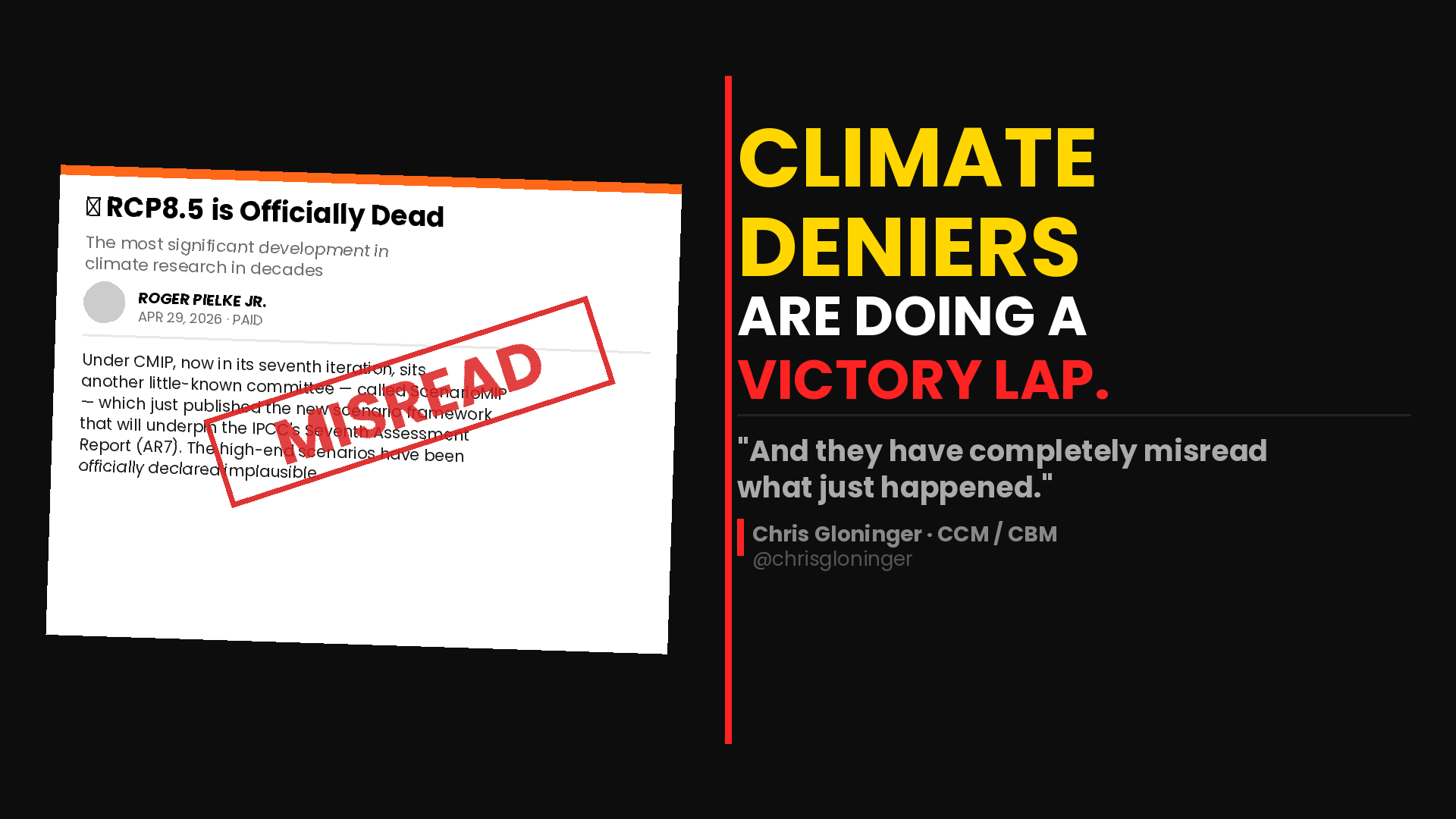
I’ve been watching my mentions light up this week. Climate deniers, fossil fuel apologists, and the usual parade of bad-faith commentators are positively giddy. The headlines they’re sharing sound like a confession from the scientific community: “RCP8.5 Is Officially Dead.” “Climate Science’s Biggest Shift in Decades.” “IPCC Admits Apocalyptic Scenarios Are Implausible.”
They want you to believe climate scientists just admitted the whole enterprise was a hoax.
Let me tell you what actually happened and why it means almost the exact opposite of what they’re claiming.
What ScenarioMIP Actually Did
The story begins not with the IPCC itself, but with a technical committee called ScenarioMIP, the Scenario Model Intercomparison Project, which operates under CMIP, the global modeling collaboration whose projections form the backbone of IPCC assessment reports.
Earlier this month, ScenarioMIP published the new scenario framework that will underpin the IPCC’s Seventh Assessment Report (AR7). Earth system model simulations are planned to start in spring 2026.
The new CMIP7 ScenarioMIP framework offers seven scenarios spanning a range from “VERY LOW” through “HIGH,” dropping the radiative-forcing target labels of the SSP era. There is no “8.5” scenario and no “7.0” scenario.
Critically, ScenarioMIP researchers wrote that the previous high-end emissions pathway “has become implausible” because of changing emissions trends, technological developments and existing climate policies.
The retired scenarios include RCP8.5, SSP5-8.5, and SSP3-7.0. That last one is worth understanding: SSP3-7.0 assumed a 2100 global population approaching 13 billion, well above any contemporary demographic projection, and a five-fold expansion of global coal use. Neither assumption survives current understandings of demographics or energy systems.
So the scenarios were retired because their underlying assumptions, runaway coal expansion, implausible population growth, no meaningful policy response, simply don’t reflect where the world is heading. That’s the science doing its job.
The Victory Lap Is Premature. Here’s Why.
Here’s where the denier narrative falls apart completely.
The warming projections from the new scenarios are still alarming. Roger Pielke Jr., whose analysis of RCP8.5’s flaws is legitimate and whose Substack post triggered most of the denier coverage, ran the new scenarios through the FaIR climate emulator used to characterize the CMIP7 set. His results: the CMIP7 MEDIUM scenario produces a 2081–2100 mean of approximately 2.56°C, and the new HIGH scenario is about 0.9°C cooler than SSP5-8.5 on an apples-to-apples comparison.
Two important caveats about those numbers. First, they come from a climate emulator, a simplified model, not from the full earth system model runs that will underpin AR7. Those full simulations are planned to start in spring 2026 and be completed about three months later. The official projections aren’t finalized yet.
Second, and this is a point Pielke himself makes, the center of the new CMIP7 scenario set sits well above current and announced policy trajectories. The new framework compressed the high end. The middle did not move far enough.
The scientist whose work deniers are amplifying is saying the new scenarios may still be too pessimistic at the high end but not pessimistic enough in the middle relative to where policy actually stands. That is not a vindication of complacency. It’s a call for more ambition.
While the new CMIP7 framework removes the most extreme pathways, debate remains over whether the replacement HIGH and MEDIUM scenarios are still too pessimistic compared with current emissions and energy trends. That debate is happening among scientists, not because the climate risk is overstated, but because the scenario architecture still needs work.
Meanwhile, the Actual Planet
While the deniers are doing their victory lap, let’s look at what the thermometers are recording.
According to ECMWF’s ERA5 reanalysis, global temperatures from the past three years, 2023 through 2025, have averaged more than 1.5°C above the pre-industrial level, marking the first time a three-year period has exceeded the 1.5°C threshold. The past 11 years have been the 11 warmest on record.
That 1.5°C three-year average does not mean the Paris Agreement target is permanently breached — climate scientists are careful to note that the target refers to long-term warming, not individual years or short windows. But it is a landmark. In Berkeley Earth’s analysis, the global mean temperature in 2025 was 1.44°C above the 1850–1900 pre-industrial baseline, the third warmest year directly observed using thermometer measurements.
When charted on a graph, 2023, 2024, and 2025 “seemed to jump up,” said NOAA climate monitoring chief Russ Vose. When averaged together, those three years shoot above the 1.5°C mark. “The last three years are indicative of an acceleration in the warming,” said Robert Rohde, chief scientist at Berkeley Earth. “They’re not consistent with the linear trend that we’ve been observing for the 50 years before that.”
Rising global temperatures intensify heat waves and other extreme weather, endangering people and causing billions of dollars in damage. Berkeley Earth calculated that 770 million people, one out of every 12 people on the planet, experienced record annual heat in 2025.
This is not the statistical signature of a problem that has been resolved.
What the Deniers Are Actually Doing
What’s playing out right now is textbook second-generation climate denial, not the crude “it’s not warming” arguments of 20 years ago, but something more sophisticated: using legitimate scientific updates to undermine the underlying science.
They can’t deny the thermometers anymore. Eleven consecutive hottest years is hard to argue with. So the new strategy is to take a methodological refinement — in this case, a scenario update that reflects real progress on clean energy and improved demographic modeling and spin it as an admission that the entire scientific enterprise was fraudulent.
Pielke’s substantive work on RCP8.5’s misuse in the research literature has been correct and important. His analysis of the new CMIP7 framework is worth reading seriously. But the outlets amplifying his findings, Climate Change Dispatch, Watts Up With That, Daily Sceptic, Principia Scientific, are not engaging with the science. They are extracting a useful headline and discarding everything that doesn’t fit the narrative they want to tell.
The Honest Bottom Line
Retiring RCP8.5 and SSP5-8.5 because their underlying assumptions were unrealistic is correct science. The scenarios were misused, including by researchers and communicators who should have been more careful, and the new framework is a genuine improvement.
But the new MEDIUM scenario still projects roughly 2.5°C of warming by late century, based on preliminary emulator analysis. Full model runs are underway. The official AR7 projections will tell us more.
And whatever those projections show, the observational record is unambiguous. The last 11 years are the 11 hottest ever measured. The three-year global average just crossed 1.5°C above pre-industrial for the first time. Scientists at Berkeley Earth, NOAA, and Copernicus are seeing signs of possible acceleration beyond the long-term trend.
Updating a scenario because the science got better is not fraud, it is science working.
I am proud to be part of this wondertful colaborative. Please support our work.

Thank you Chris. Anti vax and climate deniers there will be. They will pass from this Earth unconvinced. I remember my youth. The summers were cooler, less polluted air and water. The weather seemed not as volatile and destructive. I'm going with the science Mr.
Thanks for explaining the science!